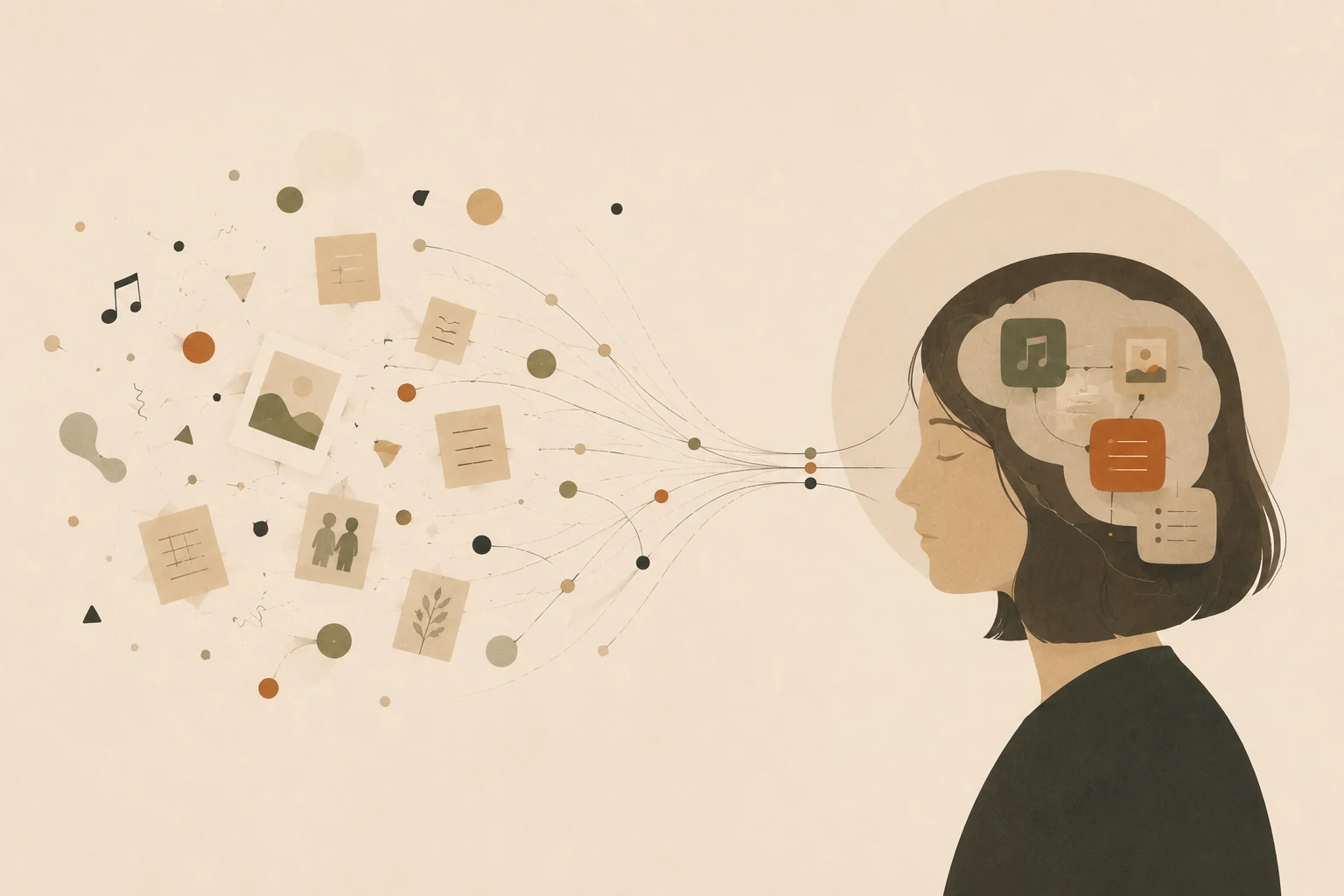

A song from your school years comes on somewhere, a shop, a cab, someone else's speaker. You have not chosen to listen to it in years. Within seconds you know the melody. You might even know what line comes next, and with it, a place, a person, an entire stretch of your life you had not thought about in ages.
Now try the other version of this. Try to explain, in any real detail, the article you read yesterday. Not the general topic, the actual content. Most people get two or three fuzzy points before the trail runs cold.
How does something from ten years ago arrive faster and fuller than something from yesterday? It is not really a question about music, or about reading. It is a question about what a memory has to survive, from the moment it enters your attention to the moment, years later, it either answers when called or does not answer at all.
Before Something Can Become a Memory, You Have to Notice It
Start at the very beginning of the journey, before encoding, before storage, before any of the vocabulary. Start with attention, because nothing downstream of it matters if it does not happen first.
You know the feeling of reaching the bottom of a page and realising you cannot say what you just read. Your eyes moved across every line. Something else did not happen. That something is called selective attention, and it is the gatekeeper deciding what gets a real shot at becoming a memory. Seeing or reading something is exposure. It is not automatically encoding. A notification, a half-finished thought about dinner, any of these can let your eyes keep moving while your attention quietly checks out. What is left afterward is the sensation of having read something, without much of the something itself.
A favourite song rarely has this problem. It gets your attention dozens or hundreds of times across years, sometimes because you chose it, often because it simply happened to be playing while you were doing something else. That is the first, unglamorous advantage it had over yesterday's paragraph. It was actually noticed, repeatedly, long before anyone got around to asking whether it would be remembered.
Turning an Experience Into Something the Brain Can Keep
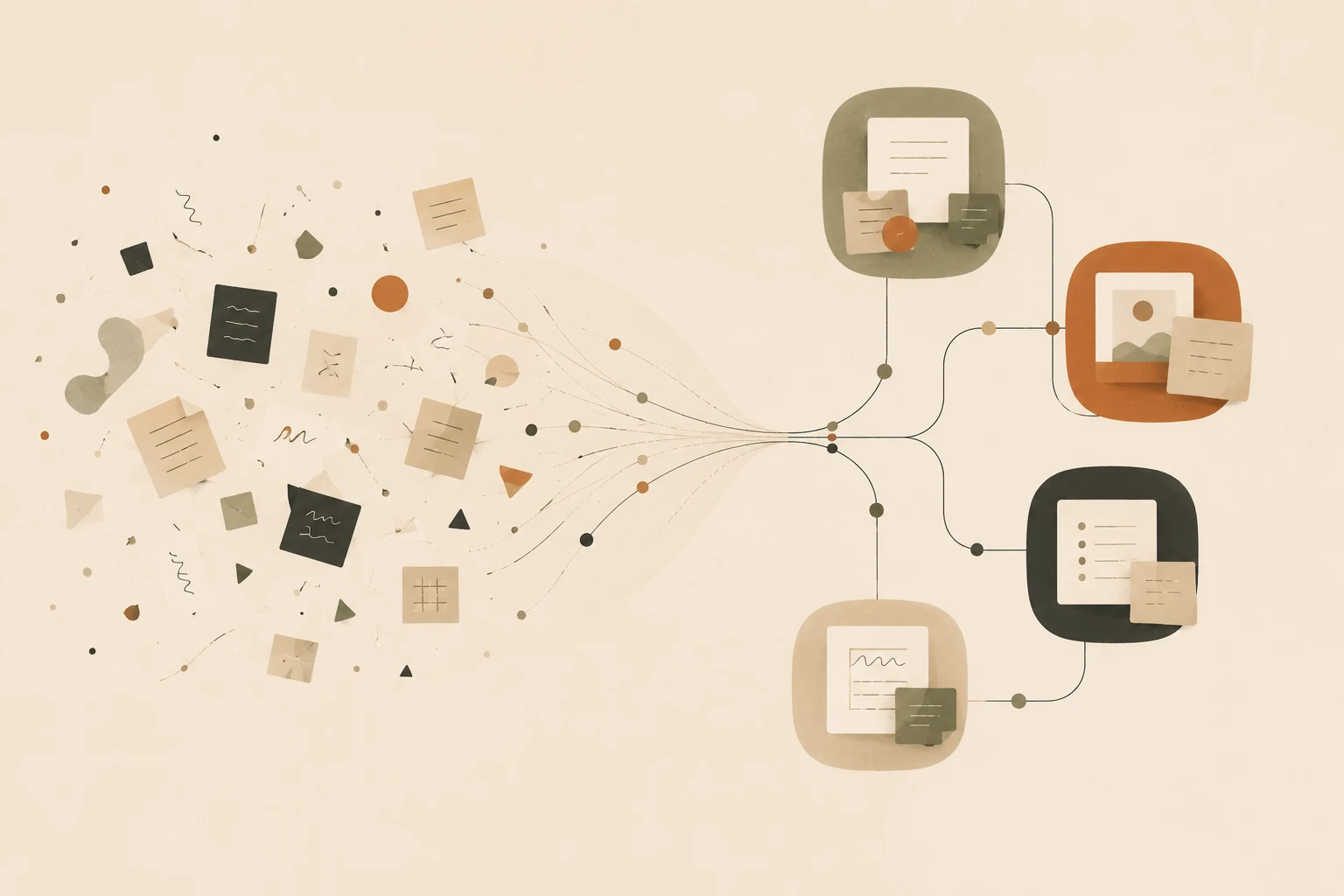
Once something has your attention, it still has to be converted into a form your brain can actually store. This conversion process is what psychologists call encoding, and it is not all or nothing. Encoding can be shallow, barely skimming the surface of what you took in, or it can be deep, wiring the new information into things you already know.
A useful way to picture this is elaborative encoding, an idea that goes back to research on how depth of processing affects what sticks. A random date is hard to hold onto. That same date connected to your birthday, or a historical event you already care about, becomes far easier, because your brain now has more than one route back to it.
Songs arrive with a version of this built in. Rhythm, melody, rhyme, and a chorus that keeps returning are not decoration. They are structure, and structure is exactly what makes something easier to encode. This connects to an idea researchers call chunking: instead of holding forty separate words in mind, your brain groups them into a handful of bigger units, a verse, a hook, a phrase that always lands the same way. A song essentially does the chunking for you, in advance, through its own repetition. A paragraph almost never offers this. It hands you sentence after sentence and expects you to build the structure yourself.
The Feeling That Tips the Scale
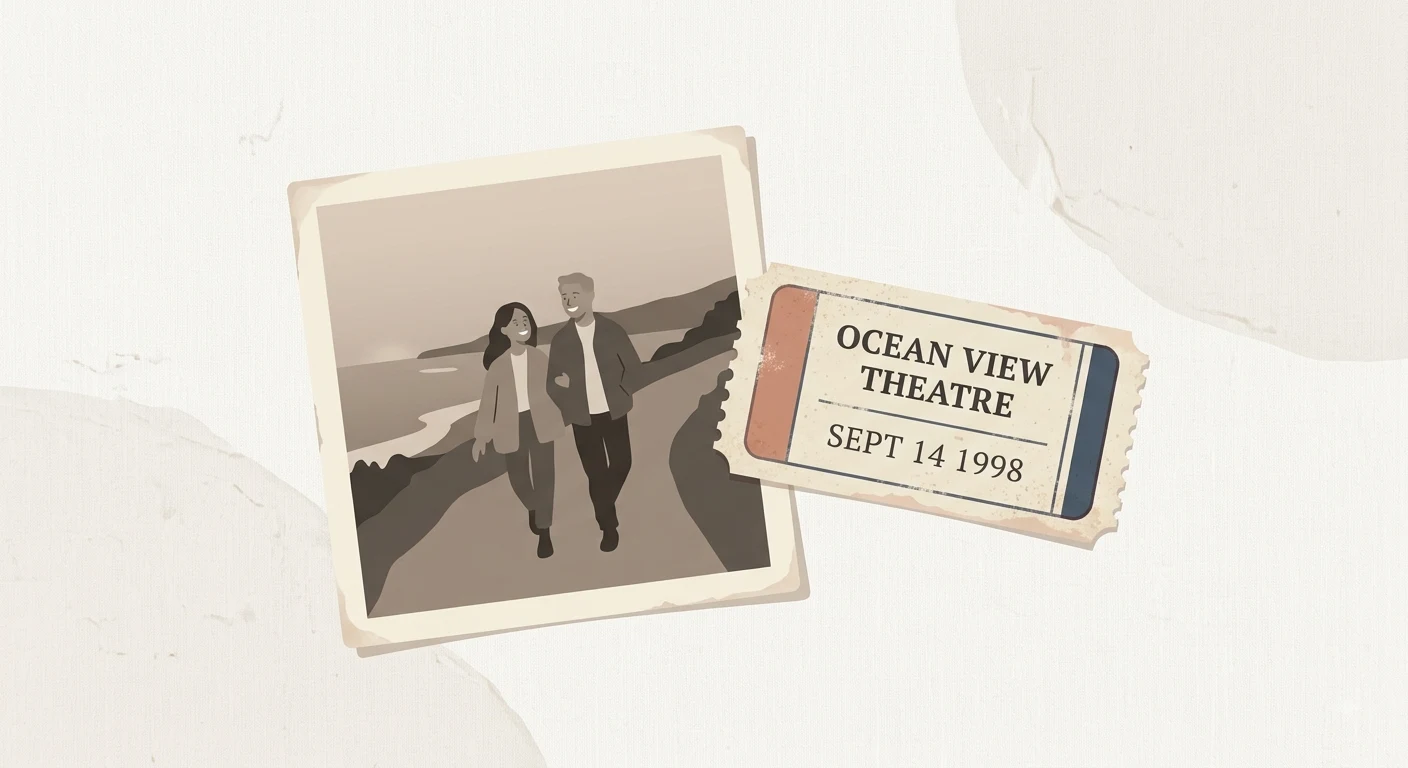
It would be an overstatement to say every emotional memory is automatically stronger than every neutral one. What research on emotion and memory does suggest, going back to work on the amygdala's role in memory consolidation, is that emotional significance can shape how strongly attention and encoding happen in the first place, making some experiences more likely to be retained in vivid detail.
Think about how a school year actually gets remembered. Most ordinary Tuesdays are gone completely. What tends to survive is a first day, an embarrassing moment in front of the class, a farewell, a specific trip, the beginning or end of a close friendship. These stood out at the time, so more of your attention went toward them, and more of your attention meant a stronger memory trace.
Songs rarely arrive as isolated information the way a paragraph does. They arrive while something else is happening, a friendship, a commute, a heartbreak, a summer. Research on what is sometimes called music-evoked autobiographical memory backs this up directly: songs are unusually effective at pulling up detailed, emotionally rich memories of specific people, places, and periods of life, more so than most other everyday cues. Your paragraph from yesterday, however useful, was probably not attached to anyone or anywhere in particular. It did not get this advantage, because there was nothing for it to attach itself to.
What Happens After You Stop Paying Attention
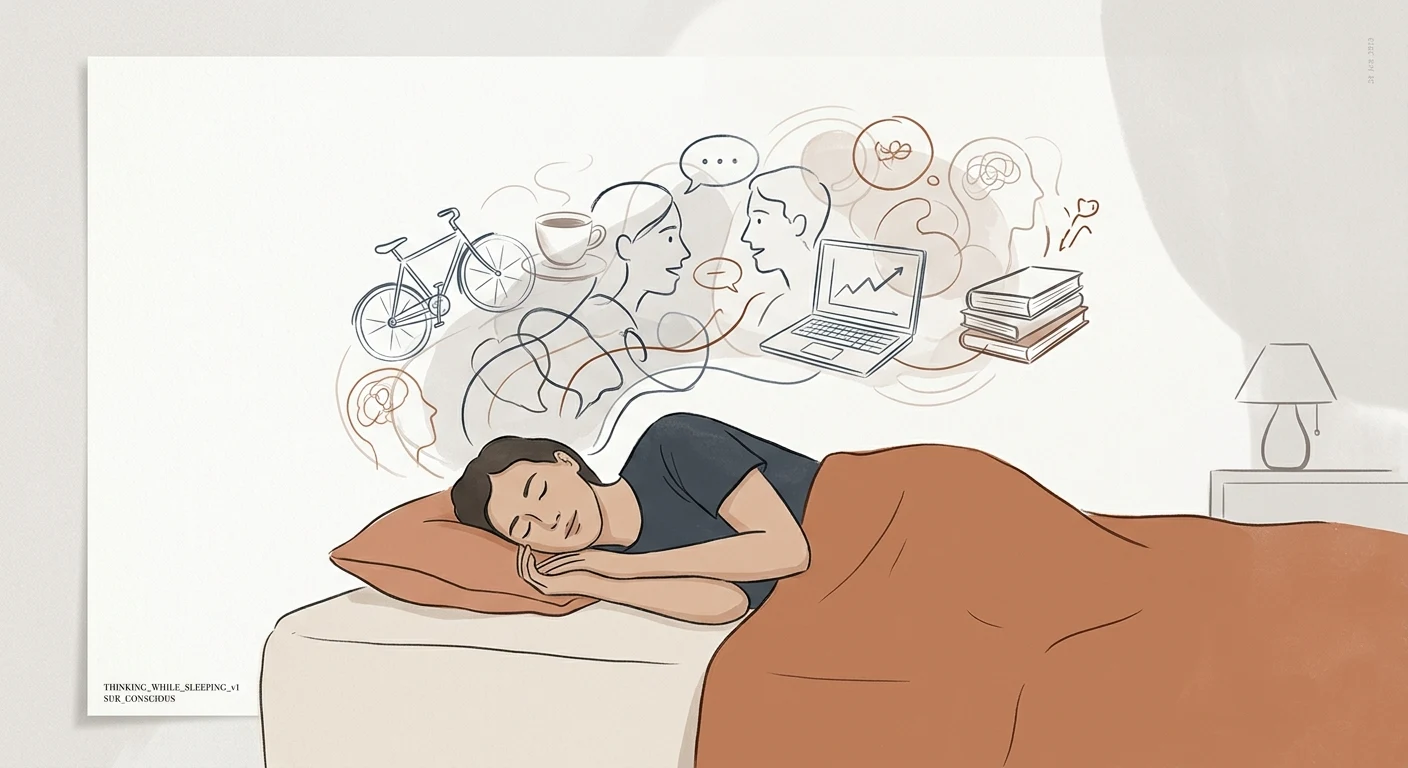
Here is the part most people have heard a simplified version of: sleep helps memory. What that actually means is more interesting than the slogan suggests.
A newly formed memory is initially fragile, easy to disrupt or lose. Over the hours and days that follow, it can become more stable through a process researchers call consolidation, and a meaningful part of this appears to happen while you are asleep. This is not a single, simple switch. Different stages of sleep seem to contribute to different aspects of memory processing, some more tied to factual information, others more involved in skills or emotionally charged experiences. The exact division of labour is still being worked out, but the broader point holds up well: your brain does not stop working on a memory the moment you close the book or the song ends.
This is also why cramming has such a mixed reputation. It can genuinely help you scrape through a test the next morning, since some of that information is still sitting in short-term storage. What it tends not to do is produce durable, long-term retention, because the memory never gets the extended, spaced-out processing that seems to matter for making something last. A song, heard across years rather than crammed into one sitting, gets exactly that kind of extended processing almost by accident.
Repetition Is Not All the Same Kind of Repetition
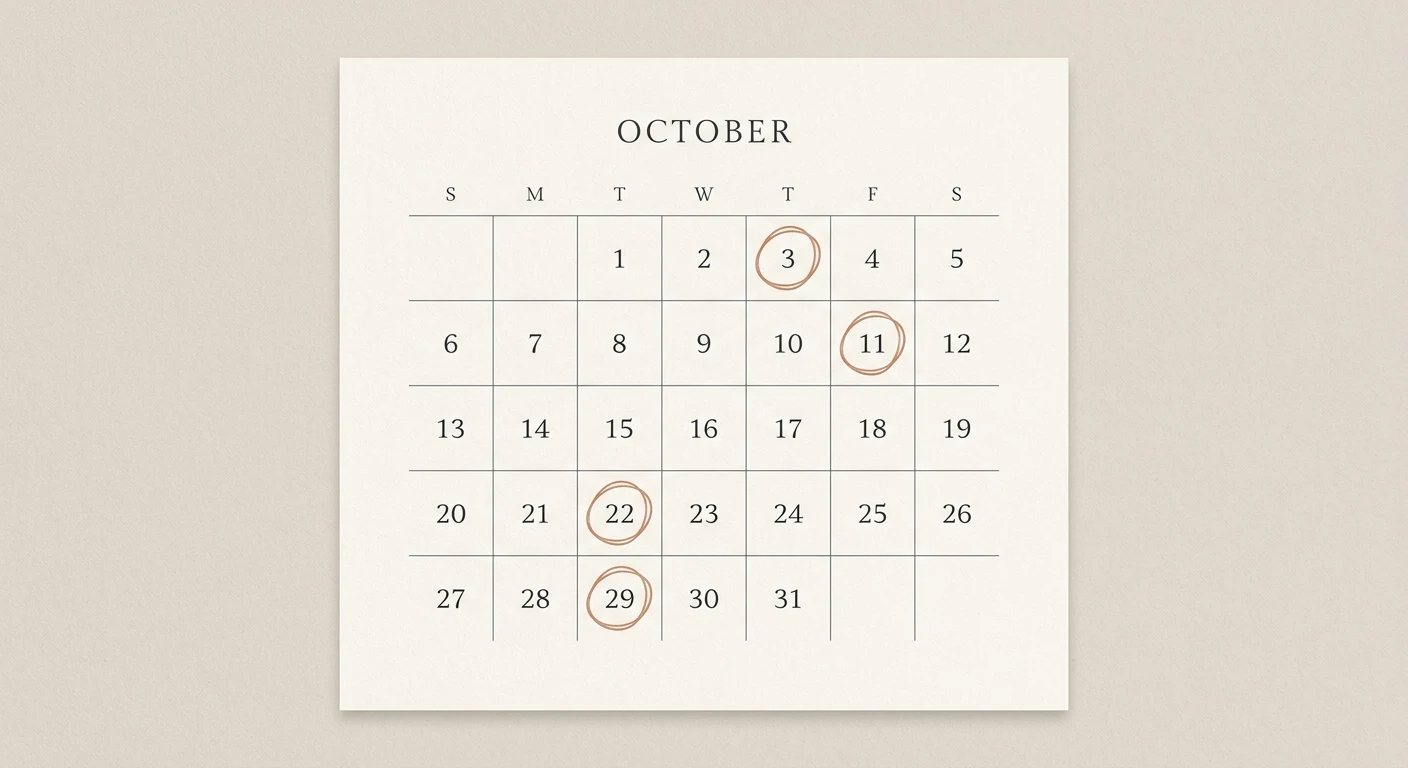
Rereading the same paragraph five times in one sitting and hearing the same song fifty times over three years are both technically repetition. They are not remotely the same thing for memory.
A substantial body of research on what is known as the spacing effect has found that information revisited at spaced-out intervals tends to be retained far better than the same amount of exposure crammed together. Massed repetition, all at once, produces a short burst of familiarity that fades quickly. Spaced repetition, returning to something after a gap, forces your brain to work slightly harder to retrieve it each time, and that extra effort appears to be part of what strengthens the memory.
A song you loved as a teenager was never played fifty times in an afternoon. It came back over weeks, months, years, at parties, in cars, through other people's speakers, each return landing on a slightly faded version of the memory and reinforcing it again before it disappeared. Rereading your notes the night before an exam is the opposite pattern: concentrated, immediate, and much weaker for anything beyond the next day or two.
Feeling Like You Know It and Actually Knowing It
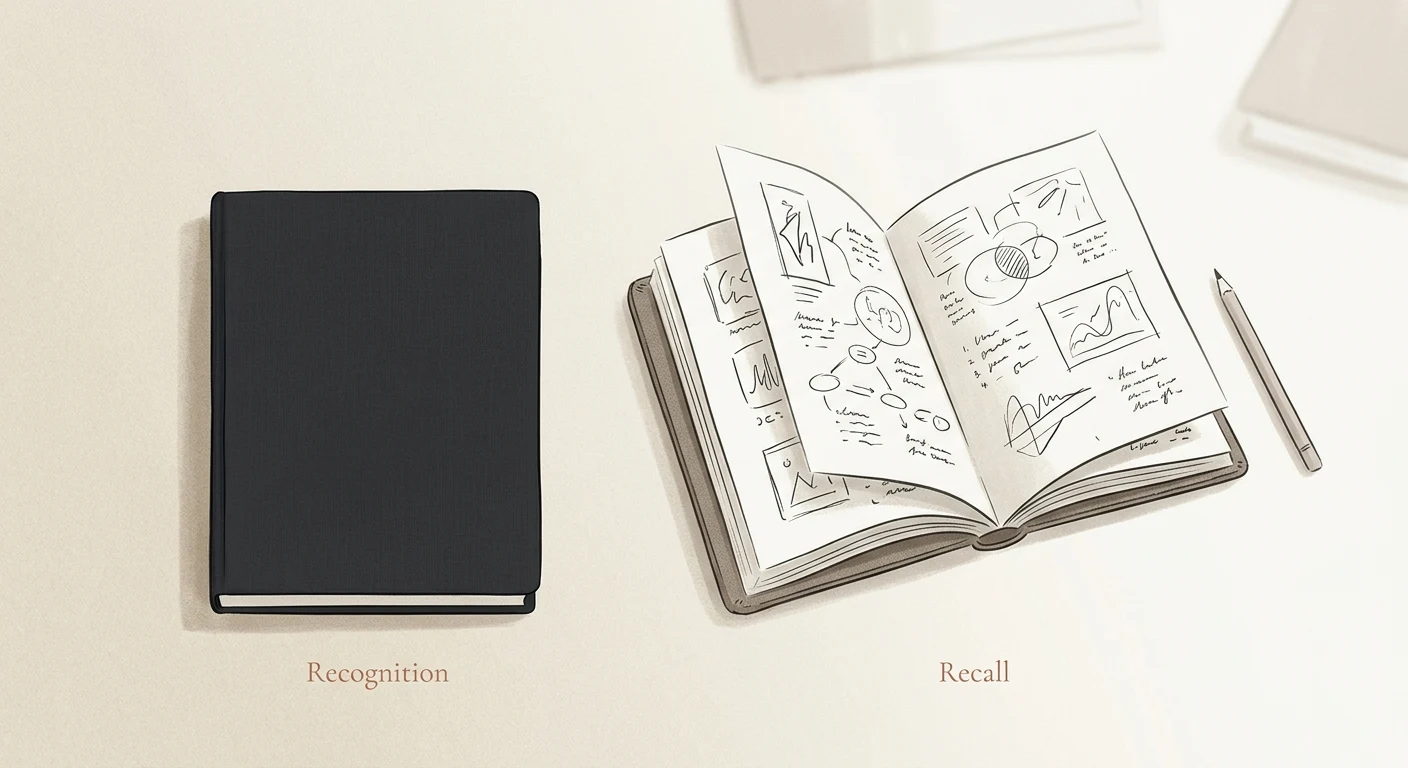
This is where a lot of the confusion around "bad memory" actually lives, in the gap between two things that feel identical but are not: recognition and recall.
Recognition is knowing something is familiar when you see it again. Recall is producing that same information from nothing, with no prompt in front of you. Rereading your notes gives you recognition. Everything looks familiar, so it feels learned. Close the notebook and try to explain the same idea out loud, and recall is a different, harder test, one that rereading never actually trained.
Music plays a strange trick here that makes the distinction easier to feel. Hear the first two seconds of an old song and the rest often comes rushing in almost automatically, the melody acting as a powerful prompt for recall you did not know you still had. Reading rarely gives you a prompt that strong. Which is exactly why it leans so heavily on recognition, the shakier of the two, and why closing the article and trying to explain it out loud, without looking, would tell you far more about what actually got learned.
Your Memories Need a Way Back In
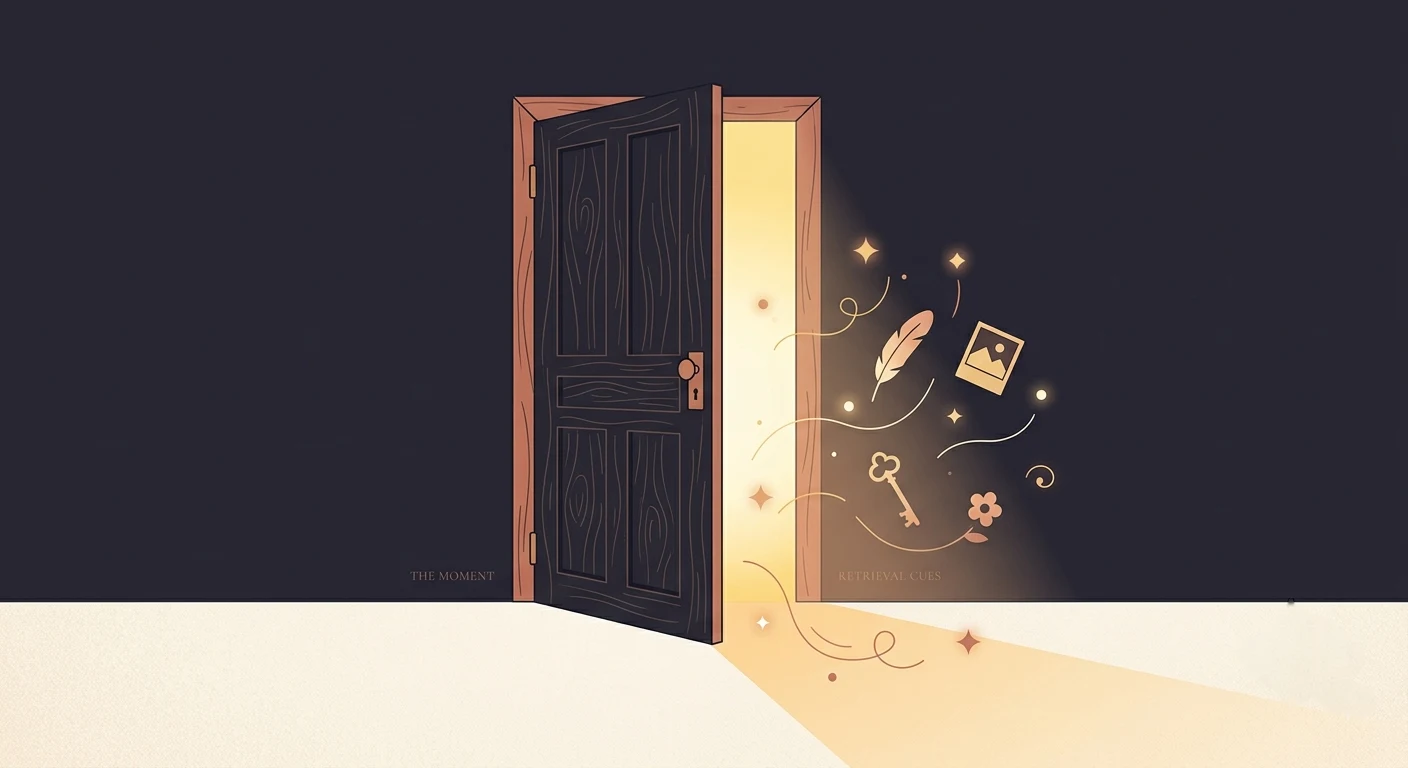
Memories are not stored like files in labelled folders, waiting untouched until you go looking for them. They are stored as networks, linked to the sensory details and context present when they were formed. A retrieval cue is something in the present that closely matches something in that network, and it can pull the whole thing back with surprising force. A smell can bring back a kitchen. A street can bring back a person. A song can bring back an entire period of a life.
Music tends to be an especially strong retrieval cue because a song is rarely tied to just one moment. It gets replayed across a whole stretch of time, attaching itself to the same people, places, and feelings again and again, which gives it far more paths back into memory than a single, isolated experience would have.
It is worth being careful here, though. Not every forgotten memory is quietly intact somewhere, waiting for the right cue. Some information genuinely weakens over time, and some connections become too faint to reactivate at all. What can be said with more confidence is this: when a memory does return in full after years of silence, it is usually because something, often music, gave it a way back in that ordinary daily life never happened to provide.
So Why Do We Forget Yesterday?

Forgetting is not really a malfunction. Your brain takes in an overwhelming amount of information every day and simply cannot treat all of it as equally worth keeping.
In the late 1800s, a psychologist named Hermann Ebbinghaus tested this on himself, memorising lists of meaningless syllables, chosen specifically because they had no built-in meaning or personal connection, and tracking how much he could recall over time. The pattern he found became known as the forgetting curve: a steep early drop, then a more gradual levelling off. Because it was built on nonsense syllables rather than real, meaningful material, it is best understood as an influential model of how forgetting tends to behave, not a precise timetable for every kind of human memory.
What the curve does capture well is this: without reinforcement, access to a memory tends to weaken. New, similar information can interfere with older material. And weak encoding in the first place, information that barely got attention or structure, can look exactly like forgetting later, even though a strong memory was never really formed to begin with. Yesterday's paragraph most likely was not lost from storage. There is a decent chance it never made it that far.
Putting the Two Side by Side
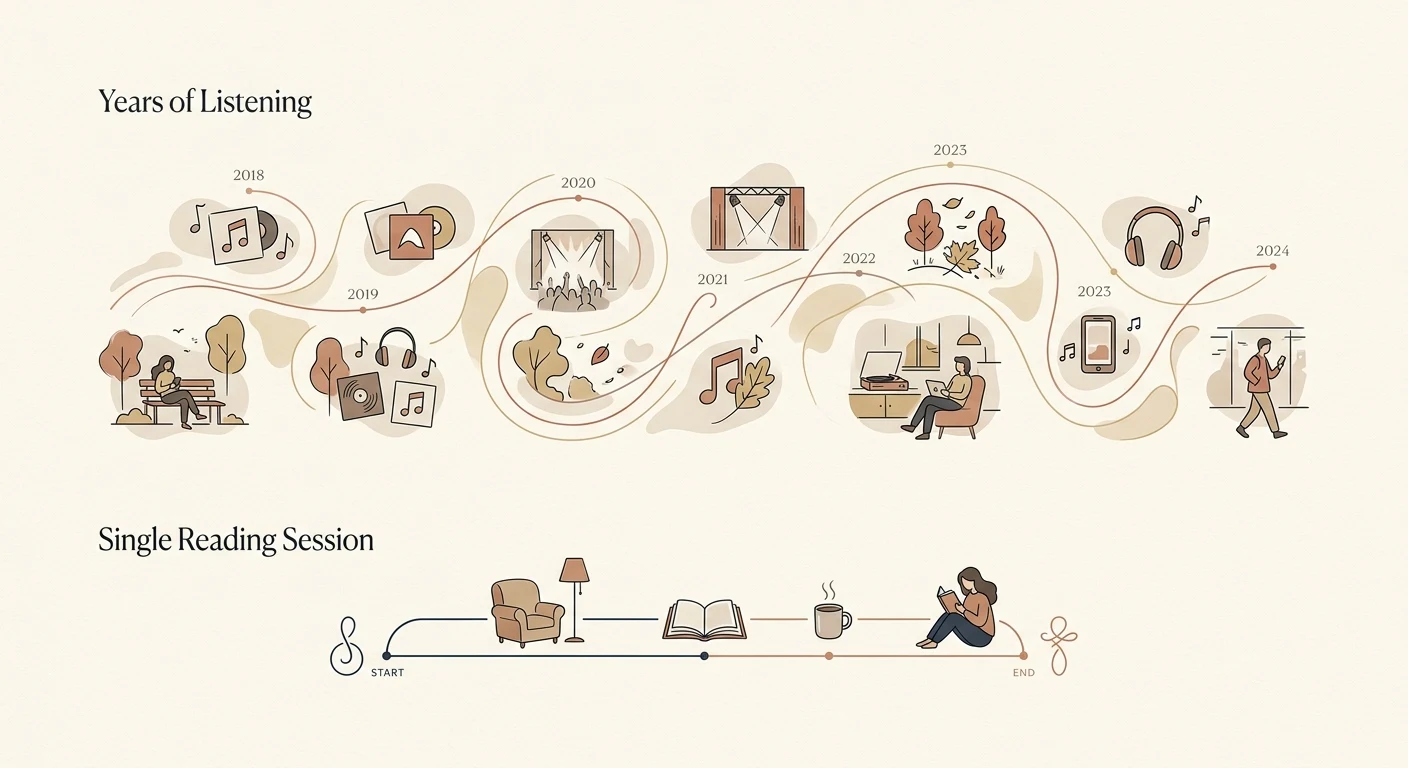
Once you walk through the whole journey, the comparison stops feeling mysterious and starts feeling almost inevitable.
Yesterday's paragraph, most likely:
- Received one pass, possibly a distracted one
- Carried little personal or emotional significance
- Had few connections to anything you already knew
- Was never deliberately retrieved afterward
- Had no spacing, no repeated exposure over time
- Left behind weak or absent retrieval cues
The ten-year-old song, by contrast:
- Was heard dozens or hundreds of times
- Arrived pre-structured through rhythm and melody
- Was repeated across months and years, not one sitting
- Became attached to specific people and places
- Carried real emotional weight
- Was supported by strong, recurring retrieval cues
Neither of these lists describes a special power the song has. They describe conditions, the same conditions that determine whether anything at all survives in memory.
What This Changes About the Way You Learn

None of this is really a study-hacks list. It is closer to a set of borrowed advantages, the same ones the song already had, applied on purpose.
Pay real attention the first time, since exposure without attention rarely becomes encoding. Connect new information to something you already know or care about, the way a random fact becomes memorable once tied to a story. Look for structure and chunks instead of treating information as one unbroken stream. Test yourself instead of only rereading, since retrieval practice, closing the book and trying to explain the idea out loud, has repeatedly been shown to strengthen memory more than passive review. Space that retrieval out over days rather than one session. And protect the sleep that follows, since that is where a meaningful part of consolidation seems to happen.
None of this makes a song out of a paragraph.
It just gives the paragraph a fairer shot at the same process that made the song survive.
Maybe the song was never proof that your memory is unusual, or unreliable, or working against you. It simply had almost every advantage a memory could ask for: attention, structure, emotion, association, consolidation, and years of retrieval cues quietly waiting in the background of an ordinary life.
Yesterday's paragraph had a few distracted minutes, and not much else.
Once you understand how a memory is actually built, the mystery mostly disappears. What should still feel a little extraordinary is that four seconds of an old song, out of nowhere, can hand you back an entire version of yourself.
How do I stop forgetting what I read the very next day?
Close the book and try to explain the main idea out loud in your own words. Testing yourself through active retrieval forces your brain to build stronger pathways to the information. Follow this up by spacing out your reviews over several days instead of doing it all in one sitting.
Why do I feel like I know my study notes perfectly until I actually try to take the test?
You are confusing recognition with recall. Rereading your notes makes them look familiar, which tricks your brain into a false sense of security. To actually learn the material, you have to practice pulling it out of your head with the notebook completely closed.
Can I still get away with cramming the night before an exam?
It might help you scrape by tomorrow morning, but the information will likely be gone by next week. Your brain needs sleep to run the background process of consolidation, which permanently stabilizes fragile new memories. Without that rest and spaced-out repetition, you never give the material a chance to stick.