

You said yes again.
You didn't want to. Your gut screamed no. But the moment you imagined saying it out loud - disappointing them, watching their face fall, risking their opinion of you - the guilt hit before you even opened your mouth.
So you smiled, nodded, and agreed to something you'll spend the next three days dreading.
Sound familiar?
If you've ever felt selfish for having needs, rude for saying no, or guilty just for protecting your own time - this guide is for you.
Setting boundaries doesn't mean you're cold, difficult, or uncaring. It means you're finally learning to treat yourself with the same respect you give everyone else. And yes, you can do it without drowning in guilt.
Let's break it all down.
First, Ask Yourself These Questions
Before we get into the how, let's check if you actually need this guide. Be honest:
- Do you feel selfish every time you say no to someone?
- Have you ever apologized for having a need?
- Do you say "yes" out of fear of being disliked?
- Do you feel responsible for other people's emotions?
- Have you ever felt exhausted from always being "the reliable one"?
- Do you rehearse saying no in your head but say yes in real life anyway?
If you nodded at even two or three of those - you're in the right place.
What Are Boundaries, Really?
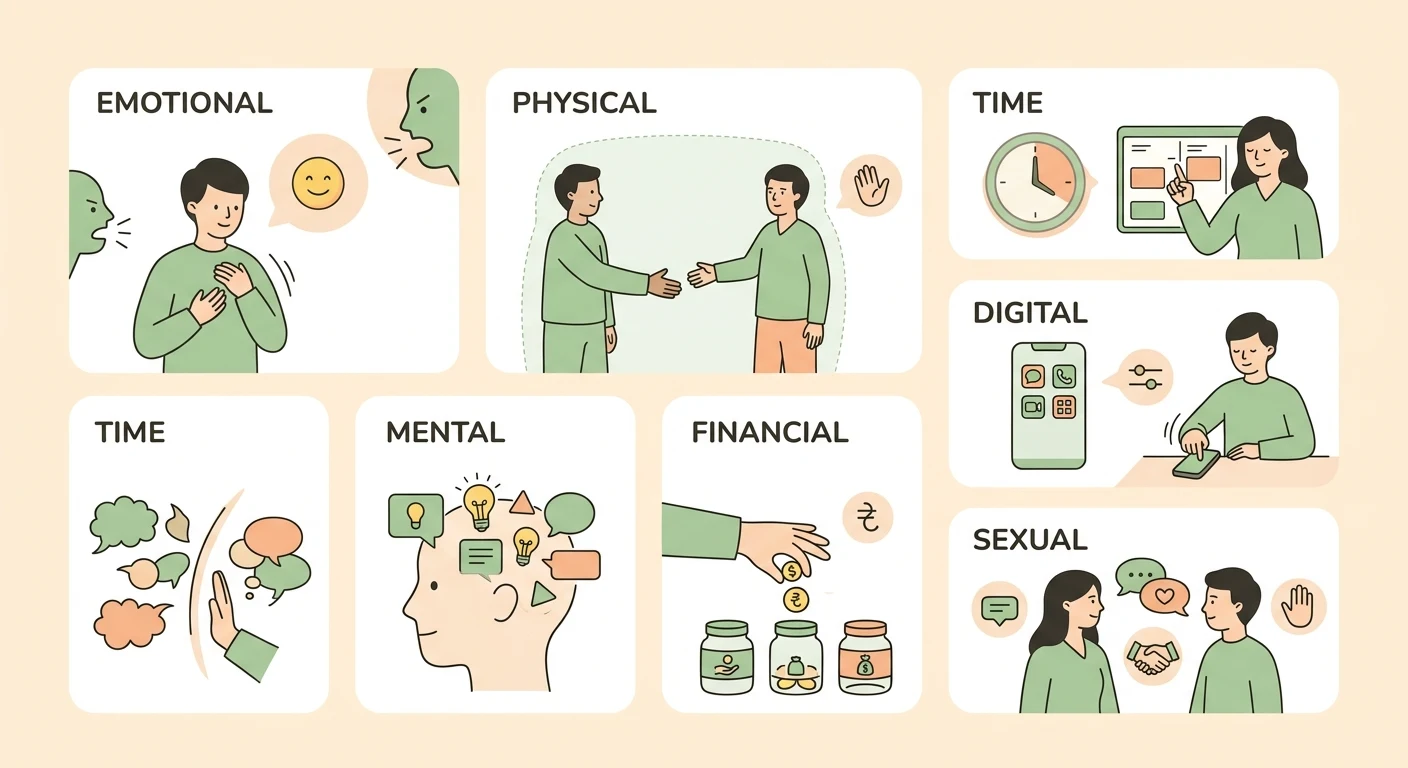
Most people flinch at the word "boundaries." It sounds clinical, cold, even aggressive - like you're building a wall around yourself and locking the door.
But that's not what boundaries are.
Boundaries are simply the limits you set about what you will and won't accept in your relationships, your time, and your energy. They're not walls - they're guidelines that tell people how to treat you.
There are several types of boundaries you probably deal with every day:
- Emotional boundaries - not taking responsibility for someone else's feelings
- Time boundaries - protecting your schedule from constant demands
- Physical boundaries - your personal space and comfort
- Digital boundaries - not being available on your phone 24/7
- Mental boundaries - the right to your own opinions without being talked over or dismissed
Every single one of these is valid. Every single one of these is something you're allowed to protect.
Why Do We Feel So Guilty?
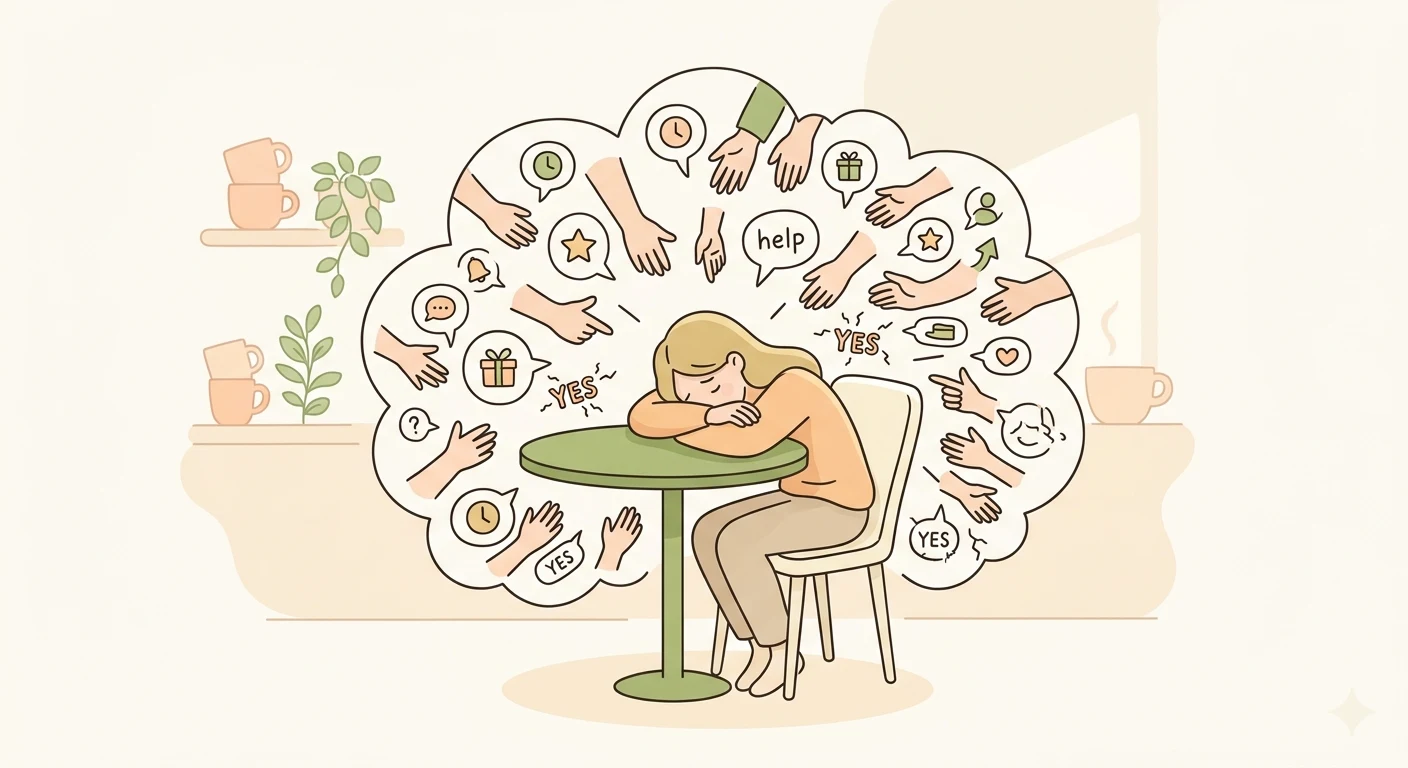
Here's the real question. You know it's okay to say no. You've probably told a friend it's okay a hundred times. So why does it feel so wrong when you do it?
Because guilt around boundaries is almost never logical - it's conditioned.
Here's where it usually comes from:
1. Childhood programming
Many of us grew up hearing things like "don't be selfish", "think of others first", or "don't make a fuss." These messages get wired deep. As adults, having needs starts to feel like a character flaw.
2. People-pleasing as a survival skill
For a lot of people, keeping others happy wasn't just polite - it was necessary. Maybe conflict at home was dangerous. Maybe love felt conditional. People-pleasing kept things stable. The problem? It follows you into adulthood, long after the danger is gone.
3. Fear of rejection
At our core, humans are wired for belonging. Setting a boundary risks upsetting someone - and that triggers a fear that they'll pull away, get angry, or think less of you. The guilt is your brain trying to protect you from that outcome.
4. Tying your worth to being helpful
If your identity is built around being "the dependable one" or "the person who never says no," setting a boundary feels like dismantling who you are - not just declining a request.
5. Cultural and family expectations
In many cultures and families, saying no - especially to elders, bosses, or partners - is simply not normalized. The social script says you give, and you keep giving.
Understanding why you feel guilty is the first step to not letting that guilt run the show.
Signs You Have Poor Boundaries
Sometimes we don't even realize how boundary-less our lives have become. Here are the signs:
- You feel resentful after helping people - and then feel guilty about that
- You say yes and spend days regretting it
- You feel responsible for fixing other people's problems
- You avoid expressing how you really feel to keep the peace
- You feel burnt out despite not being able to point to one specific cause
- You overexplain yourself constantly - justifying, defending, apologizing
- You feel anxious when someone seems even slightly disappointed in you
- You attract people who take more than they give
Does this list sting a little? Good. That means something is shifting.
How to Set Boundaries Without Feeling Guilty
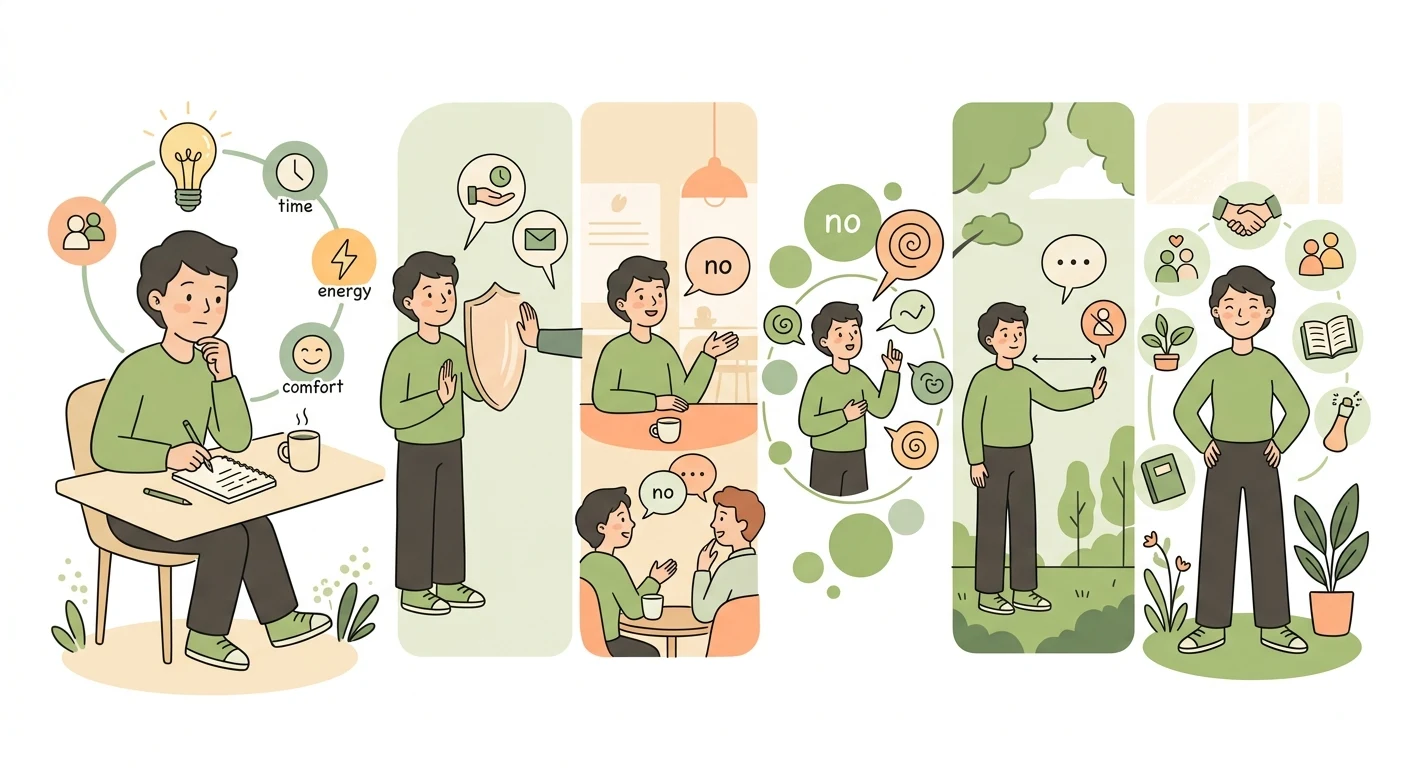
Here's the practical part. These aren't abstract tips - they're actual steps you can use starting today.
Step 1: Identify Where You're Most Drained
You can't protect energy you haven't located yet. Ask yourself: Where in my life do I consistently feel resentful, exhausted, or taken for granted?
That feeling is a signal. It's pointing directly at a boundary that needs to exist.
Step 2: Get Clear on the Boundary Internally First
Before you say anything to anyone, know what you actually want. A vague boundary is an ineffective one.
Don't just think "I need more space" - think "I'm not going to answer work messages after 8 PM." Specificity gives you confidence.
Step 3: Use "I" Statements
The goal is to express your boundary, not assign blame. There's a big difference between:
❌ "You always dump your problems on me."
✅ "I'm not in a headspace to talk about this right now, but I care about you and we can connect later."
One creates defensiveness. The other creates clarity.
Step 4: Keep It Short - Stop Over-Explaining
This is the big one. When we feel guilty, we over-justify. We turn a simple no into a five-paragraph essay hoping that if we explain enough, the guilt will lift.
It won't. And over-explaining actually signals to others that your boundary is negotiable.
Say it once. Say it clearly. Stop there.
Step 5: Expect Discomfort - And Do It Anyway
Here's the truth no one tells you: setting a boundary will feel uncomfortable, especially the first few times. That discomfort is not a sign you did something wrong. It's just the feeling of doing something new.
Guilt and wrongness are not the same thing. You can feel guilty and still be completely right.
Step 6: Reinforce It Consistently
A boundary you only hold sometimes isn't a boundary - it's a suggestion. If you say you won't answer calls after 9 PM but pick up "just this once" every time, people will keep calling.
Consistency is how a boundary becomes real.
Scripts You Can Actually Use
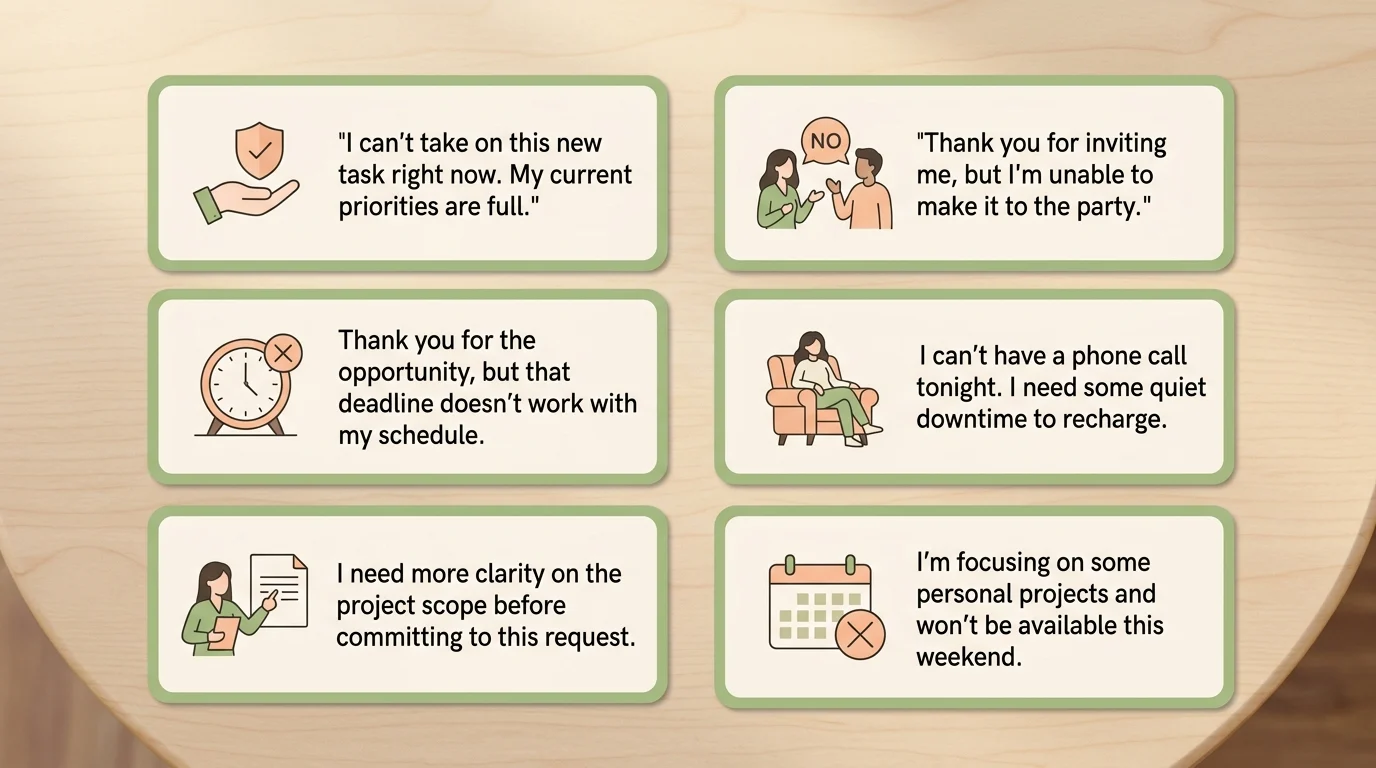
Sometimes the hardest part is finding the words. Use these as starting points:
When someone asks for your time:
"I can't commit to that right now, but I appreciate you thinking of me."
When a friend keeps venting but never asks how you are:
"I love supporting you, but I'm running low myself lately. Can we check in on each other?"
When someone pushes back on your no:
"I understand you're disappointed, but my answer is still no."
At work, when asked to take on too much:
"I want to do this well. To take this on, I'd need to hand off [X]. Which would you prefer I prioritize?"
With family, when they cross a line:
"I love you, and I'm not going to continue this conversation if it goes in this direction."
The simplest one of all:
"That doesn't work for me."
No explanation needed. No apology required.
What to Do When Someone Reacts Badly
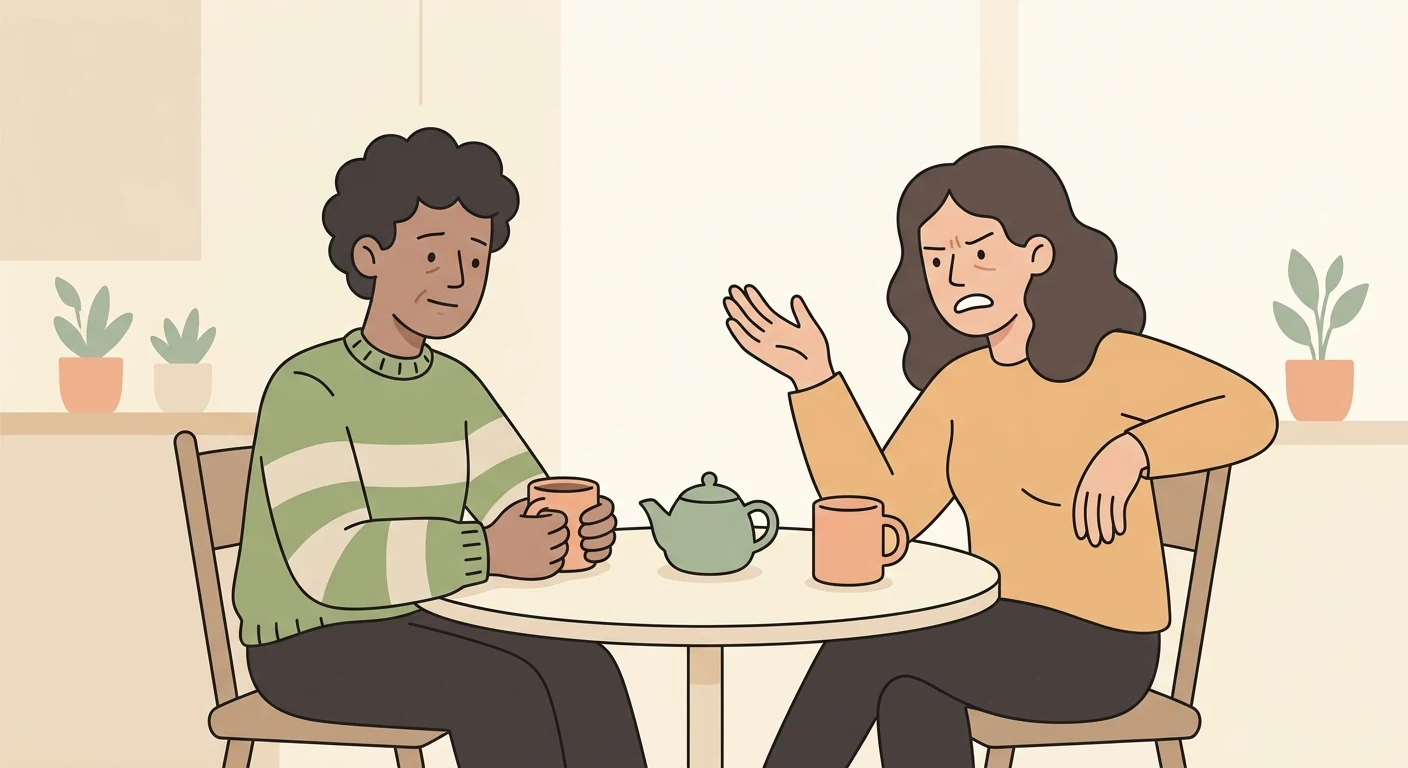
Let's be honest - some people won't like your new boundaries. They'll guilt-trip you, go cold, push back, or make you feel like you've done something terrible.
Here's what you need to remember:
Their reaction is information, not instruction. Someone being upset that you have limits is telling you about their relationship with boundaries - not yours.
Guilt is not a compass. Feeling guilty doesn't mean you were wrong. It means you did something unfamiliar. Those are very different things.
The people who truly respect you will adjust. It might take a conversation, some awkwardness, and time - but people who value you will adapt. People who only valued what you gave them will resist.
And that distinction? It's worth knowing.
The Mindset Shift That Changes Everything

Stop thinking of boundaries as something you do to people.
A boundary isn't a rejection - it's a redirect. It's you saying: "Here is how I can show up in a way that is actually sustainable."
When you burn yourself out, you don't become more available to the people you love - you become less. Boundaries don't make you a worse friend, partner, or person. They make the version of you that shows up real, present, and actually there.
That's a gift to everyone around you.
Final Thoughts

Setting a boundary is one of the most loving things you can do - for yourself and for the people in your life.
It teaches people how to treat you. It preserves your energy for the things that actually matter. And it slowly, quietly, builds a version of yourself you actually respect.
You don't have to earn the right to have limits. You already have it.
Start small. Say no to one thing this week that you'd normally say yes to out of guilt. Notice how the world doesn't end. Notice how you feel after.
That feeling? That's what boundaries are for.
Over to you - what's one boundary you've been putting off setting? Drop it in the comments below. You might just inspire someone else to do the same.
How do I deal with the guilt that hits right after I say no?
Accept that discomfort is going to happen and do it anyway. That heavy feeling is just your childhood programming acting up, not a sign that you did something wrong. Give yourself permission to feel awkward without rushing to change your mind.
What do I do if a close friend gets angry or goes cold when I set a limit?
Let them sit with their feelings and resist the urge to rescue them. Their negative reaction is just information about them, not an instruction for you to back down. People who truly value you will eventually adjust once the initial surprise wears off.
Why do I feel this overwhelming urge to explain my whole life story when I just want to say no?
Skip the long excuses because over-explaining actually signals that your boundary is negotiable. You are probably just trying to manage their disappointment, but you do not need to prove your reasons are valid. Say your peace clearly and let the silence do the rest.