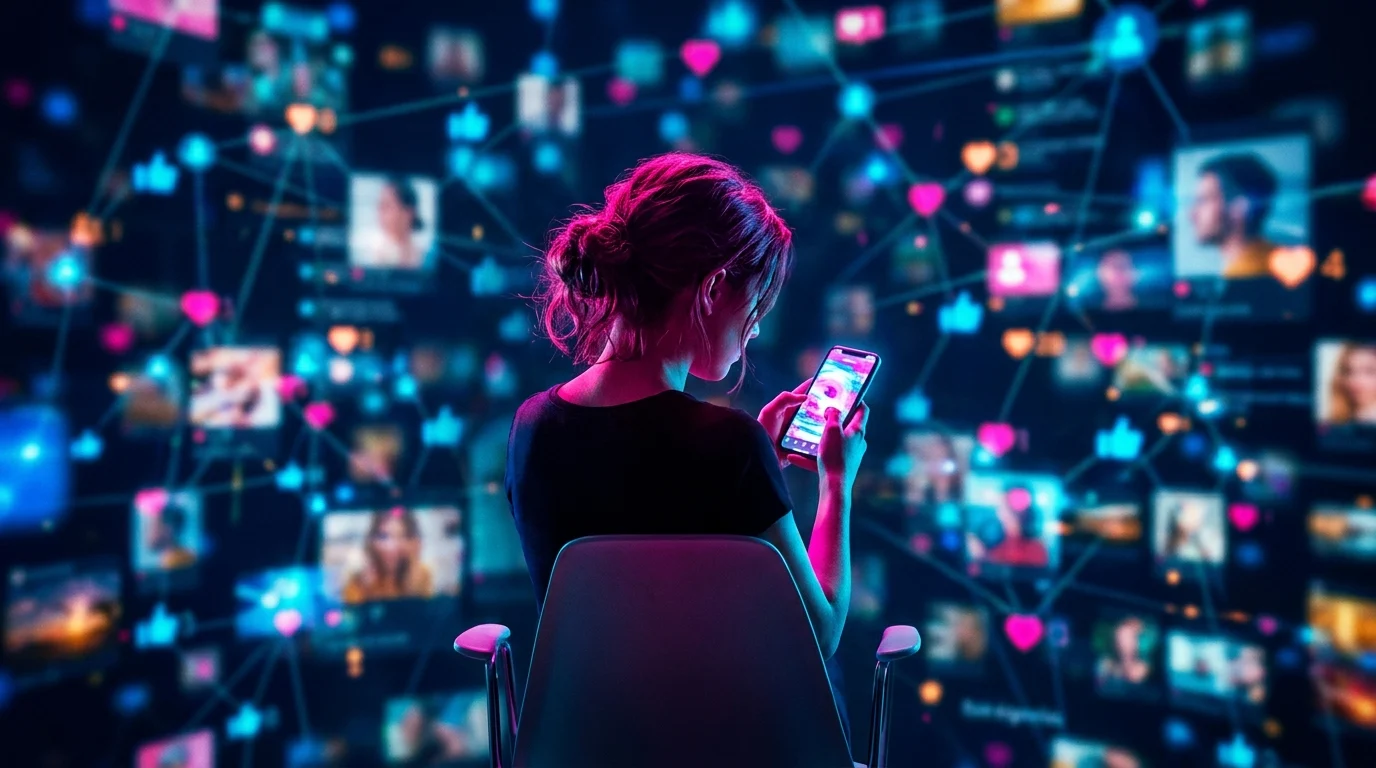

It is 11:30 PM. You are lying in bed, your thumb mechanically flicking up on your phone screen.
In the last six minutes, you have scrolled past thirty-seven videos on TikTok or Instagram Reels. You've glanced at three YouTube video titles, hovered over a dozen posts on X, and skimmed a handful of Reddit threads.
Thousands of hours of human labor, cutting-edge video editing, high-resolution graphics, and creative ideas have zipped past your eyes in seconds. Yet, as you close the app in mild irritation, your primary emotion isn't satisfaction, entertainment, or enlightenment.
It's a dull, hollow feeling of boredom.
Five seconds later, out of pure muscle memory, you open the app again.
This is the central paradox of the modern internet: we have access to more human creativity than at any point in history, yet everything feels sanitized, predictable, and remarkably dull.
It's easy to blame yourself. You might assume your attention span is shot or that you're just suffering from digital burnout. But what you are experiencing isn't a personal cognitive failure. It is a structural byproduct of the modern web, a phenomenon known as Algorithmic Fatigue.
The Death of Serendipity
To understand why the internet feels so stale, you first have to look at how dopamine actually operates in the brain.
Pop psychology often frames dopamine as a simple reward chemical, something released when you experience pleasure. But neuroscientists have long known that dopamine is actually driven by anticipation and surprise.
Your brain doesn't release its biggest surge of dopamine when receiving a predictable reward. It hits peak release during a surprise, specifically when an outcome turns out significantly better or more unexpected than anticipated.
This pattern is well-documented in behavioral neuroscience. Research on reward prediction errors, pioneered by Wolfram Schultz and his team, demonstrated that dopamine neurons fire based on the gap between what we expect to happen and what actually occurs. The key takeaway is simple: genuine surprise is what keeps us engaged.
For a deeper dive into the neuroscience and the studies behind this idea, see The Goldfish Myth.
Interactive: The Dopamine Predictability Flatline
In the early days of the web, online discovery was completely un-optimized. You stumbled across obscure blogs, grainy webcam videos on early YouTube, niche forum threads, or weird personal fan pages. There was zero guarantee that anything you clicked would be worth your time.
Because expectations were low and unpredictable, finding an incredible piece of content felt genuinely exciting. The web was built on genuine digital serendipity.
The Math of Zero Surprise
Modern recommendation engines, driven by complex vector embeddings and collaborative filtering, were built specifically to eliminate that uncertainty. Their goal is straightforward: analyze billions of data signals like watch time, scroll speed, hover duration, and past likes to serve content you are mathematically unlikely to scroll past.
On paper, this sounds ideal. Why spend time sifting through bad posts when an algorithm can deliver a 99% match every single time?
The catch is glaring: when a system becomes exceptionally accurate at predicting your taste, it wipes out all contrast.
When every clip on your feed aligns with your exact demographics, mood, political leanings, and aesthetic preferences, your brain registers zero surprise. The algorithm delivers a steady, flatline stream of mildly enjoyable media. By eliminating the risk of showing you something you might dislike, it simultaneously destroys the chance of showing you something that genuinely blows your mind.
It is the digital equivalent of an endless buffet where every single dish has been engineered to taste like a slightly different variation of plain vanilla.
The Factory Line of "Engagement"
Algorithmic fatigue isn't just affecting viewers. It is equally damaging for the people creating the content you see daily.
To understand why so many videos feel identical, consider what it takes to publish content today.
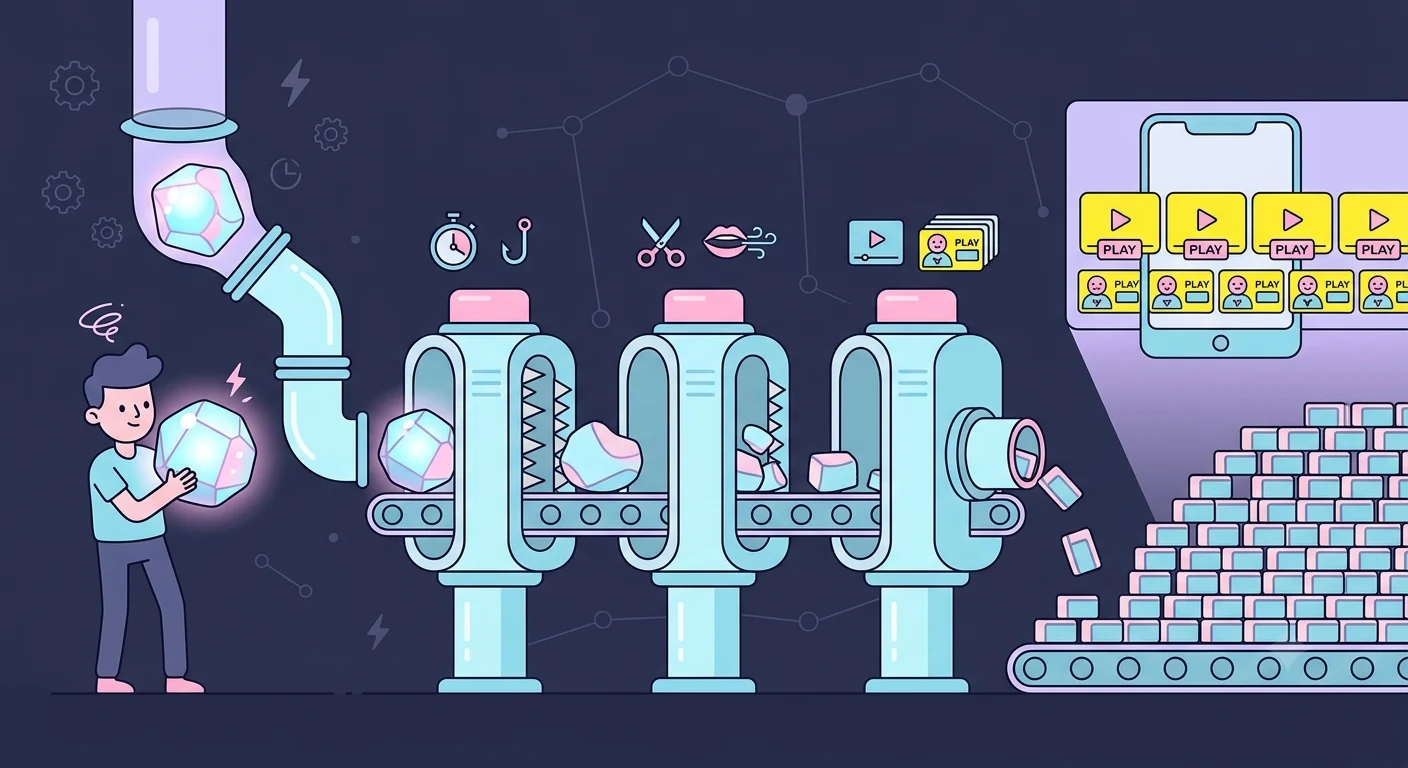
A decade ago, creators could film whatever genuinely interested them, hit upload, and trust that subscribers would see it in a simple chronological feed. Today, chronological feeds are practically extinct. Almost every major network, including YouTube, Instagram, TikTok, LinkedIn, and Spotify, places an algorithmic gatekeeper between creators and their audience.
To stay visible, creators can no longer prioritize pure self-expression. They have to design for algorithmic metrics:
- The 3-Second Hook: If a user swipes away in under three seconds, the platform suppresses the clip. The fix? Sudden edits, rushed delivery, bold text overlays, and dramatic opener lines like "Stop scrolling if you want to know..."
- Pacing Without Pause: Brief pauses or moments of reflection trigger drop-offs. The fix? Splicing out every breath, speeding up narration, and cluttering the frame with constant screen movement.
- Thumbnail Homogenization: Click-through rate drives reach. The fix? Over-the-top facial expressions, oversaturated lighting, and neon red arrows pointing at everyday objects.
The Invisible Editor
The algorithm effectively acts as an invisible, non-negotiable editor. When millions of creators are evaluated by the exact same mathematical parameters, their creative outputs naturally converge on the same stylistic formulas.
That is why every tech review on YouTube shares the same moody backdrop and cinematic intro. It is why travel clips on Instagram rely on the same pitch-shifted sound bite. It is why productivity videos feature the exact same warm desk lamp and leather journal setup.
The algorithm doesn't just dictate what gets recommended, it dictates what gets made in the first place. You aren't bored because your mind can't focus. You are bored because thousands of distinct human creators are being pushed by algorithms to sound like the exact same person.
Trapped in a "Local Maximum"
In computer science and optimization theory, there is a well-known concept called a Local Maximum.
Picture a hiker trying to climb to the highest peak in a mountain range through thick fog. If their only rule is "keep walking upward," they will eventually reach the top of a small hill. From that spot, every step in any direction leads downward. The hiker assumes they have reached the summit, completely unaware that a much taller mountain stands just a few miles away, separated by a deep valley.
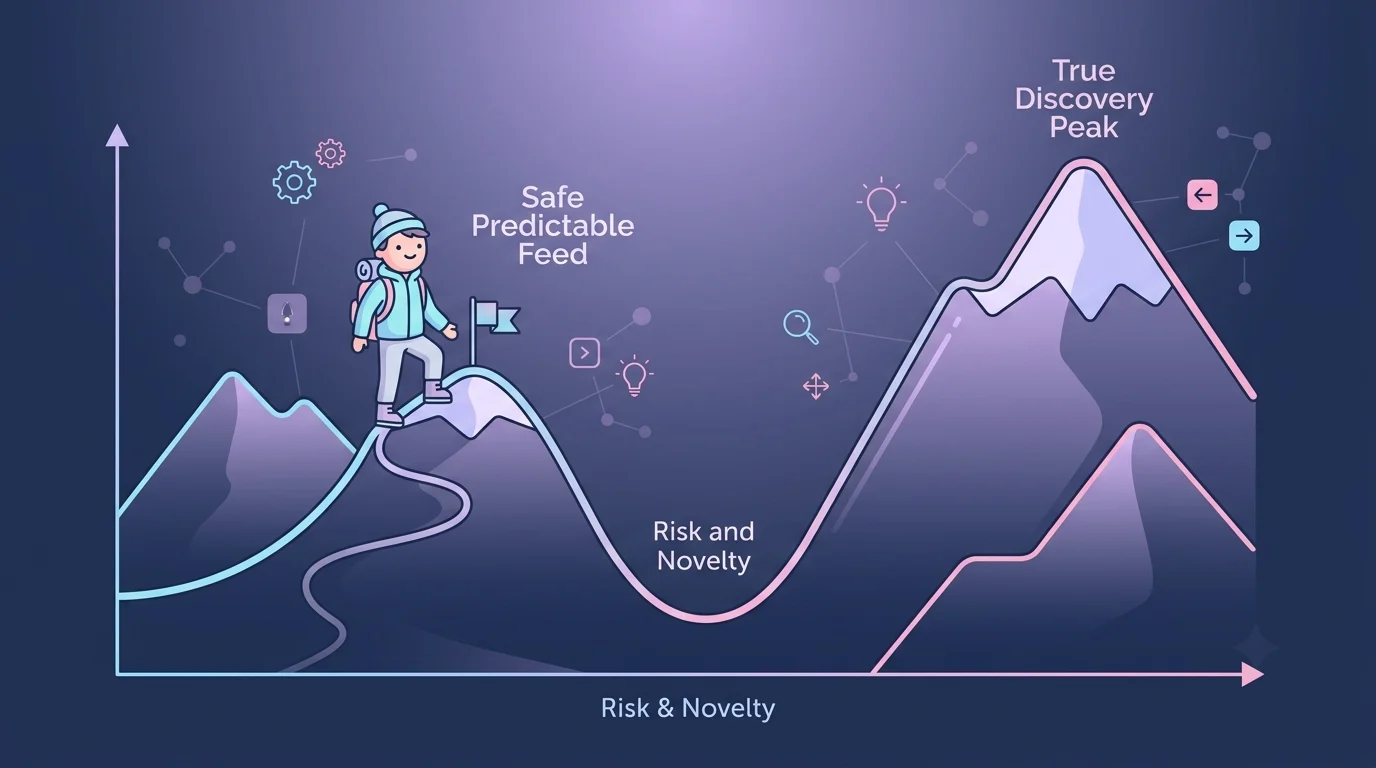
Recommendation algorithms operate on this exact principle.
If you linger on a short video about mechanical keyboards for twenty seconds, the system makes a safe play and serves you fifty more videos about mechanical keyboards.
Stepping off that hill to test your interest in a deep-sea oceanography documentary carries a risk, as you might scroll away instantly and drop the platform's session metrics. So the algorithm plays it safe, keeping you on the comfortable hill of keyboard videos.
Over time, your online footprint shrinks. You end up boxed inside a feed built entirely out of past habits. The web stops feeling like an open expanse and starts feeling like a tiny, repetitive loop.
How to Re-Wild Your Digital Life
While you can't rewrite platform algorithms, you can actively disrupt the predictable loops they try to build around you.
Here are three practical ways to bring genuine discovery back into your daily browsing:
Poison the Data Trail
Search for subjects outside your lifestyle (e.g. 15th-century pottery, marine ballasts). Confuse the predictive vectors to unlock un-optimized content.
Reclaim Friction
Bypassing "For You" feeds in favor of direct RSS feeds, independent newsletters, and explicit subscription tabs.
Seek Un-Optimized Media
Spend time on chronological text forums, full un-shuffled albums, physical books, and unedited long-form conversations.
Final Thoughts: Taking Back Control of Surprise
The internet isn't lacking creative talent. Millions of insightful writers, artists, and creators upload compelling work every day.
The core issue is that distribution channels are optimized for safety and predictable retention. In designing for constant engagement, the modern web accidentally stripped away what makes media truly rewarding: the joy of unexpected discovery.
The next time you catch yourself scrolling mindlessly through endless clips while feeling completely unengaged, don't wait for the feed to suddenly improve.
Close the app, step away from the screen, and break the loop. Human culture was never meant to be flattened into an engagement formula.
Why do I feel so bored scrolling social media when there are millions of things to watch?
Your brain actually craves surprise, not just endless content. Because recommendation engines are too good at predicting what you like, they eliminate the unexpected moments that trigger real dopamine. You end up in a flatline loop of medium-good posts that never actually blow your mind.
Is my attention span actually ruined, or is the internet just getting worse?
Stop blaming yourself because your focus is actually fine. The real culprit is that content has been completely homogenized by mathematical formulas to keep you hovering on the screen. When thousands of creators are forced to use the same editing tricks just to get seen, everything naturally starts feeling dull.
How can I actually get my social media feed to show me interesting things again?
Start by intentionally searching for random, obscure topics like historical pottery or deep-sea biology to confuse the tracking vectors. You can also bypass the algorithms altogether by switching to chronological feeds, direct RSS subscriptions, and independent newsletters. Taking back control requires introducing a little bit of manual friction into your browsing habits.
Why does it feel like every content creator uses the exact same editing style now?
Creators are practically forced to edit this way because platforms will bury their videos if they do not capture your attention in three seconds. To survive the algorithm, they have to strip out natural pauses, use aggressive hooks, and design identical-looking thumbnails. It is not a lack of creativity, but rather a survival tactic to get past the platform's digital gatekeepers.